

This article is part of the series Recalculating, a 28-day motorcycle journey along the Pacific Northwest coast and through its volcanic landscapes.
It had been five months since I was laid off, and my new relationship with time still caught me by surprise. I had finally let go of what the word Monday was supposed to mean, embraced Wednesday as my favorite day of the week, and settled into the fact that I didn’t have a particular date when I needed to be home.

No one was requiring me to return on August 4. There was no meeting waiting for me the next morning, no deadline forcing me south, and no reason I couldn’t stretch the trip out for another day or two. For twenty-eight days, that freedom had been one of the great gifts of being on the road.
But my body and mind were ready to be home. For most of the trip, freedom was waking up, packing the motorcycle, and pointing it toward somewhere new. On this final day, it meant allowing myself to stop.
One More Night on the Road

I could have pushed all the way home from Fortuna, but doing so would have meant missing a rare opportunity to see my friend Larry. He moved to the East Coast a few years ago but happened to be in Fort Bragg while I was passing through. We may cross paths again when I travel east, but there are no guarantees. I had spent enough of this trip measuring days in miles. Like I found out in Happy Camp, seeing a close friend mattered more than getting home a few hours sooner.
Once I committed to stop in Fort Bragg, I made another choice that was slightly out of character for this trip: I spent a little extra money on a nice hotel room.
For most of the previous month, lodging had been a practical transaction. I needed a bed, a shower, some electrical outlets, and a reasonably secure place to park the motorcycle. Anything beyond that was difficult to justify when I would pack everything again the next morning and leave.

This was my final night on the road, though, and I didn’t want it to feel like one more thing to endure before getting home. The room cost more than I would ordinarily spend, but it had a view across the water toward an old wooden bridge and the fog beyond it. I put my things down, looked out the window, and enjoyed being there without immediately calculating when I needed to leave.
It was worth it.
I had learned something about pushing too far during the long haul between Government Camp, Oregon, and Vancouver, British Columbia. Just because I can do something doesn’t necessarily mean that I should do it. That 375-mile day was hard on me, and it took a couple of days to recover. The tendons in my throttle hand continued expressing their displeasure for at least a week.
Rather than piss off my body again, stopping in Fort Bragg made sense. I had chosen a friend, a comfortable room, and a shorter final day over another test of endurance. That felt less like giving in and more like finally paying attention. I took the morning to hang out with Larry before leaving. I also needed a postcard, a magnet, and a good walk. Larry knew where to find the answer to all three.

It was a win-win situation. We both got to be social, I didn’t have to hop on the big motorcycle and wander all over town looking for souvenirs, and the place he brought me was pretty kick-ass: the Skunk Train and the beach walkway.
Several people had mentioned the Skunk Train after hearing I was headed through Fort Bragg, but Larry was the right person to visit it with. If anything, Larry is a railroader. He knows locomotives, railcars, track gauges, and where all the local rail once went. He explained the rockslides and closures along the Skunk Train’s route from Fort Bragg to Willits.

These days, much like California’s Highway 169, the railway no longer completes its original journey. A tunnel collapse in 2015 severed the route, cutting the trip significantly short. Larry could see all of it—the equipment in front of us, the route that used to exist, and the pieces that no longer connected.
Eventually, it was time for me to make my own final connection.
The Coast Let Go
I said goodbye to Larry, loaded the motorcycle, and started south.
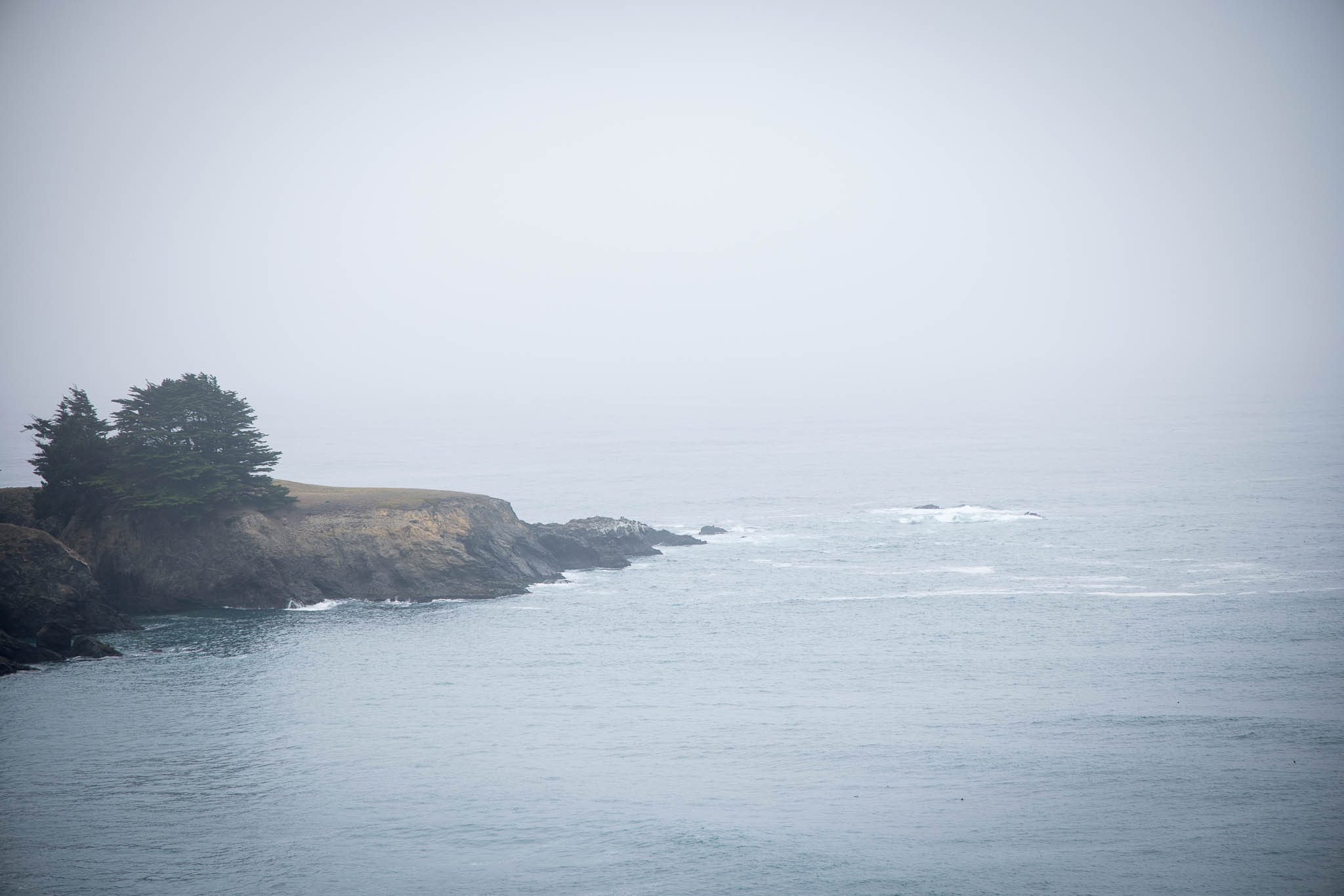

As I left Fort Bragg, I quickly reacclimated to the coast. Fog blanketed the landscape, obscuring familiar landmarks and giving everything an almost mystical glow. It couldn’t have been more different from the coastal riding I had experienced earlier in the trip. The weather remained shockingly cool, bouncing between the high 50s and low 60s, although I knew that wouldn’t continue once I turned east.
Over the years, I’ve fallen in love with Highway 128. It’s faster than taking Highway 1 all the way down the coast, but it isn’t a soulless freeway like this section US 101. It also avoids the aggressive local traffic on Highway 20 between Fort Bragg and Ukiah. Highway 128 is twisty, but the traffic engineers also optimized it for speed, making it my regular choice between the coast and the inland valleys.

The road began beautifully. It wound beneath gigantic redwoods while still holding on to the coastal fog and cool air. For a while, it felt as if the coast might follow me all the way home.
Farther inland, the summer heat began chipping away at the ocean’s grip on the climate. Every few turns, the temperature climbed another degree. The only thing slowing that progression was an ardent and situationally unaware out-of-state tourist driving twenty miles per hour below the speed limit, apparently unaware that the turnouts for slower vehicles somehow applied to them too.
Get-there-itis (n) – an informal term for plan-continuation bias, a dangerous mindset in which an operator stubbornly insists on reaching a destination despite worsening weather, mechanical warnings, or hazardous conditions. It is usually driven by impatience, schedules, or pressure.
When I finally broke free of the slow tourist traffic, even the cement trucks five miles ahead knew how to use the turnouts.
Grrr.

About ten miles from the coast, the valley took control of the thermostat. The temperature quickly shot up to 102 degrees, and unlike the day before, there would be no relief waiting beyond the next ridge. For the rest of the ride, I wasn’t going back to the coast. There would be no more cool shelter from the water and no fog to soften the afternoon.

I still had a long way to go before reaching the slightly cooler air of the Richmond–San Rafael Bridge and the traffic of the Bay Area.
Highway 128 passes through only a handful of small towns, and if I remember correctly, just two have gasoline. I wanted to make it all the way to US 101 before stopping, both to find a better price and to move beyond the halfway point of the day’s journey.
Mile after mile, turn after turn, and degree after degree, the heat began wearing on me. I slowed down and lingered through the stretches with tree cover, absorbing the small moments of shade they offered. I wasn’t in danger, but I was tired and hot.
By the time I reached US 101 near Cloverdale, the temperature had fallen into the mid-90s. I remember thinking it was pretty messed up that 94 degrees felt refreshing.
I decided to keep going.
What I hadn’t accounted for was the lack of gas stations between Cloverdale and Healdsburg, a gap of nearly twenty miles. I didn’t want to exit, turn around, and head north again. I thought I could make it, but I slowed considerably because the motorcycle gets much better fuel mileage at lower speeds, especially with the side bags increasing its wind resistance.
I didn’t want to run out of gas in that heat. Still, being stranded a few miles from a gas station at the northern edge of the San Francisco Bay Area sounded better than blowing a tire somewhere deep in the rural Pacific Northwest.
I was rolling the dice hard on this one. I finally made it to Healdsburg and pulled into the gas station with 9 miles of estimated range remaining. It wasn’t the closest I had ever cut it, but it was the second closest.

The final day had its own version of get-there-itis. I needed to managed it.
The Long Way Home

I wasn’t sure how to approach the Bay Area while minimizing traffic and gridlock. I hoped Google Maps would route me farther north, where afternoon southbound traffic would be easier to navigate than the eastbound alternatives. Unfortunately, Google Maps insisted that I continue down US 101 and cross the Richmond–San Rafael Bridge.
What little relief came from the breeze blowing off the bay was quickly offset by not one but two stalled cars in the right-hand lane of the bridge. Why, oh why had they opened that lane for commuters? They could have left it closed and spared everyone two painful zipper merges.
Once I crossed the bridge, Google Maps delivered another low blow by sending me along Richmond Parkway. I truly hate that piece of asphalt. Red light after red light, it just kept going. After Richmond Parkway, the route continued eroding into surface streets, dragging me around until I finally reached Highway 4. Apparenty I-80 was that bad for the commute.
Finally, I was free to ride at the speed limit, not toward another distant point on the map, but toward home.
Pressing Stop
For twenty-eight days, I had trained myself to look for what was unfamiliar: a road I hadn’t ridden, a town I hadn’t visited, a landscape I hadn’t photographed, or a place I hadn’t yet learned how to pronounce. Now I was looking forward to recognizing things.
Even from the motorcycle, I could tell my town had changed. One familiar building was simply gone — I hadn’t expected the place to keep moving without me while I was away. I had spent twenty-eight days moving through places that were never going to wait for me. Somehow, part of me had still expected home to remain exactly as I had left it.
It hadn’t.
I rounded the corner and began taking stock of my own neighborhood. I wasn’t looking at mountains, coastlines, bridges, or unfamiliar roads anymore. I was noticing ordinary things: houses, trees, intersections, and the subtle evidence that life had continued while I was away. As I rolled through the final intersection, I saw one of my neighbors driving past and waved. They waved. I could feel the warmth again.
I was home.
I pulled into the driveway beneath the tree, settling into not only its shade but the comfort of home itself. I didn’t need to find a place for the night. I didn’t need to check the weather in the next town, study tomorrow’s route, or decide whether I could make it to another gas station. I could leave something unpacked because I would still be there in the morning. I could sleep in my own bed.

For most of the trip, packing the motorcycle each morning had felt like freedom. Somewhere along the way, packing became the thing I was required to do. Each day still held something new, but constant motion had gradually become its own routine. By the end, the possibility I wanted most was the possibility of staying still.
I had traveled 3,000 miles over twenty-eight days. I was thankful for the roads, the landscapes, the people who made time for me, and the privilege of having enough time to make the journey at all. I was equally thankful that the next morning would not require a destination.
I reached over and pressed the red stop button. The engine went quiet, and the trip was over.
For twenty-eight days, the question had been: Where next? That evening, I was grateful not to need an answer.




Leave a Reply