
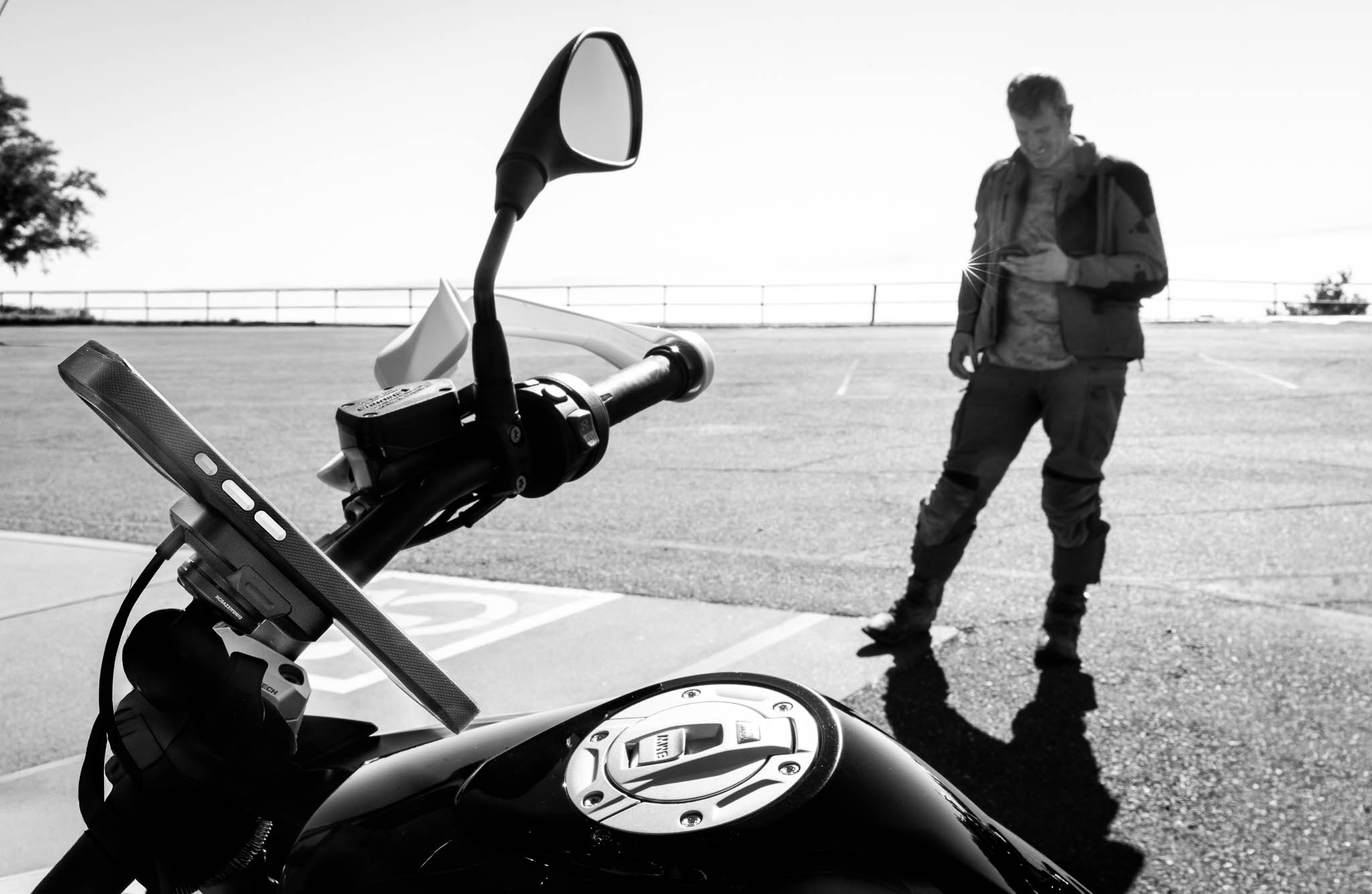
I got tired of unplugging my phone every time I stopped the bike.

Gas station. Unplug. Lunch. Unplug. Photo stop. Unplug. Back on the bike. Plug back in.
I’d been using a Peak Design phone mount on the GS for a while. It was solid — the case fit well, the magnetic mount worked, and the phone stayed put. But that one small friction point showed up every single time I stopped, and once you notice it, you don’t stop noticing it.
So when Peak released their Qi2 wireless charging mount, I paid attention. It’s not cheap, but if it meant I could just grab the phone and go without thinking about cables, it might be worth it.
The Setup
Peak Design makes you commit to their ecosystem. You need their case to use their mount, and you need their Qi2 charger to get wireless charging. I was already in with the case, so adding the charger was straightforward (though I’d really love a yellow case 😃.

I mounted it using their RAM ball adapter on the left side of the handlebars where my old mount lived. For power, I’m using this dual USB-C adapter that plugs into the GS’s powerlet socket—I like having two USB ports and a voltage readout. The Peak Design charger connects via USB-C.
The GS makes the connection easy as with the aforementioned adapter, I have switched USB power. On the Speed Triple, I’m not so sure how I’d get access to switched power as I’d be concerned about phantom drain from the Qi2 charger. Quadlock makes a cable that has an inline switch. Maybe that’s the way to go while Peak iterates on a solution here. If you’re on a bike without switched power, that’s something to think about.
Installation took maybe fifteen minutes. No drama.
The Real Test
This summer’s Pit-Ho Rally became the stress test I didn’t plan for. I had the iPhone 17 running Loop (for diabetes monitoring), Spotify, Google Maps, and feeding navigation to the CarPlay screen on the dash. At night I’d be processing and storing 45-megapixel RAW files from the R5 throughout the trip.
My phone really is turning into a computer of it’s own.
This shift matters. Traditionally I’ve always thought of my phone as basically an appliance. Pro vs standard, storage size, none of it seemed to matter much other than did I want the Pro or the Pro Max as a screen size and form factor decision. I always went pro as I wanted the premium camera offering. Max was a screen size issue I’ve gone with and without over the years. Now I’m asking a lot more from my phone than I used to, and limits were starting to show up.

I didn’t start the day fully charged. I thought I’d be fine. However, it was HOT that day. Temps were between 95 and 105. I was running, ARBP (the EV mapping app) as I wanted to see it run on a CarPlay device (Rivian sadly has a religious war against CarPlay), and running Loop, Spotify, and wireless charging all at the same time. My Phone, physics, and thermodynamics were being pushed the thing to its limit.
The battery wasn’t dropping, but it wasn’t charging either. It was just… staying alive.
What I’m Learning
In most riding scenarios—navigation running, maybe music, moderate temperatures—the Qi2 charger does great. I love that I can snap the phone on, ride, and grab it at stops without thinking about cables. The magnetic connection is secure enough that I don’t worry about it coming loose, and wireless charging just works by default.
I’m learning that a charger is not a charger. There are different standards, different speeds, different outputs. I installed one of these 60W Leviton dual USB-C outlets in the kitchen at home—it’s fast enough to charge a laptop and makes a noticeable difference with the phone too. On the bike, with a cable, I get a stronger charge. With the Qi2, it’s a touch slower.
And I’m learning you can’t outrun physics and chemistry. Heat plus wireless charging plus heavy processing equals a phone that’s working hard just to maintain status quo. On cooler days or with less running in the background, it’s not an issue. But when you’re pushing everything at once, you hit limits. I’ve also learned that ABRP uses more power than Google Maps. I don’t see as much battery strain with Google Maps as I do with ABRP.
I now keep an eye on the battery level to make sure it’s at least staying even. If I know I’m going to be running everything hard all day in the heat, I might switch back to a cable for that ride.
Worth It?
Yes — with one caveat.
The convenience is real. Being able to grab the phone and go — no cable, no cable wear, no fumbling at gas stops — makes the entire experience smoother. It removes just enough friction to matter on every single ride.
But wireless charging isn’t magic. If you’re running navigation, music, CarPlay, and pushing the phone hard in hot conditions, you’re asking a lot. In those situations, the charger keeps up — but barely. The phone stays alive, not necessarily gaining ground.
For normal riding, cooler days, or lighter use, it works exactly the way you want it to. Snap it on, forget about it, and ride.
It’s a meaningful upgrade for everyday riding. I love mine. Just be honest about how hard you’re pushing your phone. I still carry a cable in my bag just in case anything happens with the charger as the phone manages my diabetes.
Additional Win: Peak’s mount has vibration isolation keeping the delicate camera electronics isolated from the vibration of the bike. I’ve not had a claim with Apple to fix the camera since using Peak’s mounts (with or without wireless charging).
Leave a Reply