

This article is part of the series Postcards to Dad, a five-week motorcycle journey from Savannah to Maine highlighting the Appalachian Trail, with postcards home to Dad from each state on the trail.
Once again, I really enjoyed my time in New Jersey. My fraternity brother, his partner, and I made the most of a second visit, and two days flew by. My buddy headed out Sunday afternoon, leaving his partner and me to cook dinner together that evening. His partner had made meatballs and a marinara sauce the night before, and had spent part of the afternoon making pesto. Tonight we were having salmon and pasta. He was making traditional semolina pasta with pesto, while I opted for shirataki noodles with the marinara from the night before. Shirataki noodles have almost no carbohydrates, making them a pretty good substitute for pasta when I’m managing my blood sugar. I pushed him a little on the pesto, suggesting we put some directly on the salmon rather than limiting it to the pasta. After all, part of the fun of cooking is experimenting a little.

As I stirred the marinara, I was reminded of both the simplicity and the joy of cooking, especially Italian food. I don’t often think of myself as Italian. I’m pretty staunchly American, but I can’t deny how deeply Italian culture influenced my upbringing. My mother’s cooking was thoroughly Italian, and we grew up eating all kinds of dishes from that part of the world. It’s an incredibly broad and diverse cuisine, from Parmesan to piccata to saltimbocca, and so much of it feels familiar to me. I’ve told myself repeatedly that now that I have more time, I want to spend more of it cooking. Yet somehow, I’m still constantly running from one place to another, rarely taking the time to settle into my own kitchen and explore. It’s something I genuinely enjoy, but something I don’t seem to make nearly enough room for.
What made this evening particularly enjoyable was cooking with somebody who really appreciates the art of it. My fraternity brother’s partner knows the cuisine, enjoys working with the ingredients, and has an enthusiasm for creating something that other people will enjoy. There’s an art and a fluidity to both cooking and conversation, and the two seem to work especially well together. Cooking by yourself, for yourself, is an entirely different experience from sharing a big kitchen with someone who loves being there, music filling the space, and a good meal gradually coming together. We weren’t simply preparing dinner. We were enjoying the process of making it, exchanging ideas, and spending time together. This is when cooking is at its best for me: surrounded by art and community.
The next morning, I was running again. A third significant weather system was approaching, and it was time to head south. First came the nor’easter, then the hurricane, and now a solid cold front was preparing to push temperatures from the 80s into the 60s, with overnight lows in the 40s. I wanted to make the most of the remaining warmth. We’d stayed up late, and it was clear I hadn’t gotten nearly enough sleep. Today was going to be powered by Coke Zero.
One of my jobs along the way was agile coach. In agile, one of the main concepts is estimating work. Some agilists use a technique called story pointing, where work gets a number from the Fibonacci sequence (2, 3, 5, 8…) based on how complex it is. Let’s explore.
I want to eat an apple. We’ll assign the apple 2, because it’s relatively simple: wash it, bite into it. Next, I want to eat an orange. That’s a little harder, because you have to peel it, so we’ll give it a 3. Finally, I want to eat a lemon. A lemon looks like an orange, and you peel it the same way, so we’ll also give it a 3.
The problem with that estimate is that we’ve considered the peel without thinking much about what happens afterward. Take a bite of that lemon, and it’s sour and far harder to eat than an orange. It looked like an orange, but it certainly doesn’t eat like one. That was the discovery of today. Montclair, New Jersey, to Winchester, Virginia, was just 280 miles on the freeway, only 60 to 90 minutes longer than the ride from Tahoe back to the Bay Area. I couldn’t have been more wrong on this one.
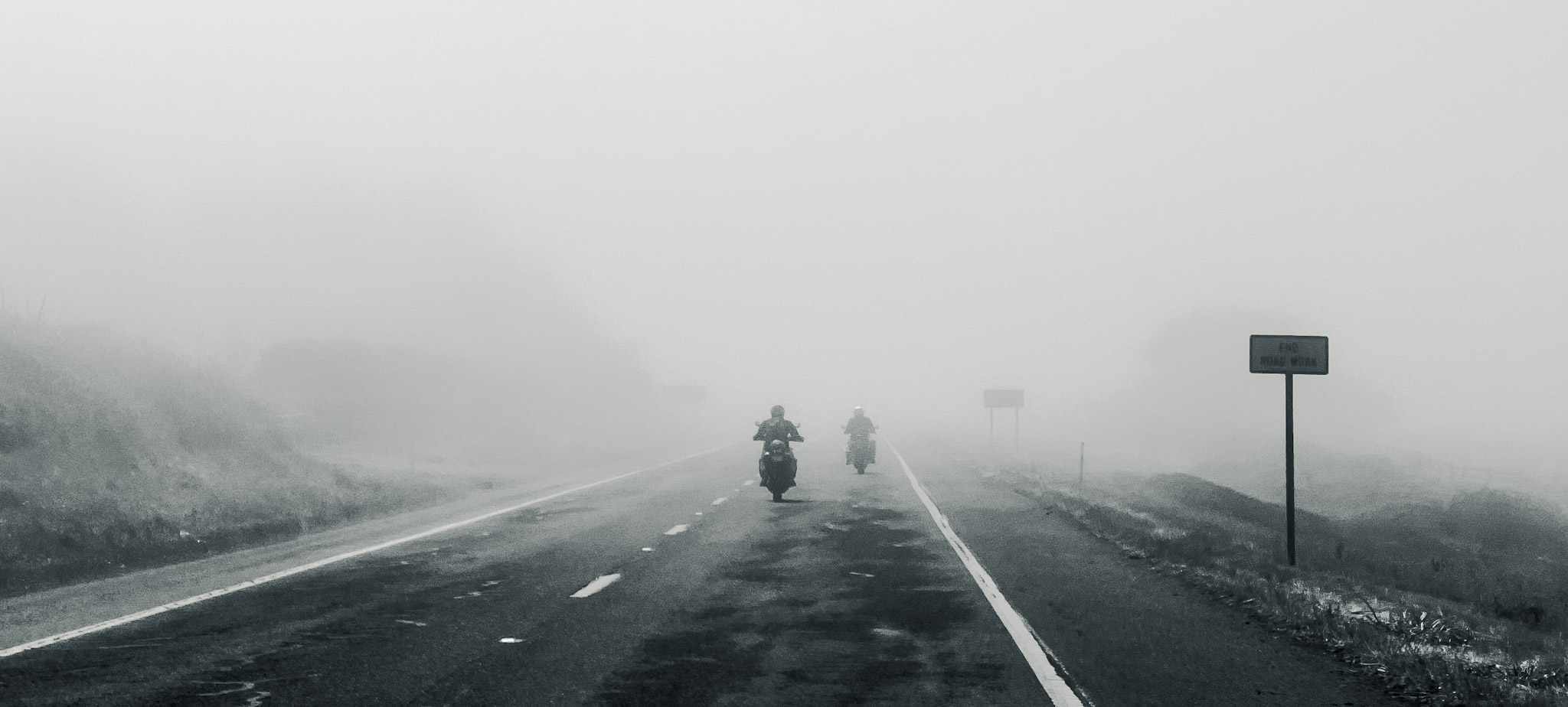
Once I was out of the New York City metro area, I expected a fairly peaceful, rural ride along Interstates 78 and 81. I got the rural part somewhat right and the peaceful part completely wrong. Traffic out of the metro area was what I’d expected. Freeway merges were painful, and construction dotted the landscape, in places closing the shoulders on both sides. Breaking down on a motorcycle with nowhere to go is a scary proposition. I’m shocked that NJDOT closes both shoulders.

Soon enough, I crossed into Pennsylvania. Literally everybody I talked to on the way north and south complained about the roads in Pennsylvania. On the way north, I’d barely used the freeway there. It had been a network of country roads, generally in good repair, and I’d wondered what everybody was complaining about. Interstate 78 answered that question. It was littered with construction all the way across the state. Lanes were closed and traffic backed up. Cars, trucks, and 18-wheelers all jockeyed for position on an already overstressed freeway. The area wasn’t really urban, but it wasn’t exactly rural either. It was a constant stream of medium-sized towns pulling traffic off the freeway and dumping more back on.
Big, heavy trucks wanted to park in the left lane, going a few miles an hour under the speed limit and choking the flow of traffic across the Pennsylvania landscape. More than once, I was boxed in by tractor-trailers on all sides. I felt my own vulnerability every time a trucker let off the accelerator right next to me and the engine growled. I could look to my right and see the spikes on the truck’s wheel spinning at way too many RPM to even think about counting. The lack of left-lane discipline across Pennsylvania honestly amazed me. Traffic backed up for thousands of feet because someone was unwilling to leave the left lane. It wasn’t only the stereotypical Prius, either. Cars, trucks, and 18-wheelers of all persuasions did it. I don’t know if it’s a cultural thing here or some shared understanding with the police that the speed limit is the speed limit, no matter what lane you’re in.
The ride from Tahoe is scenic and unhurried on anything but a Sunday afternoon. This was an absolute slog. I told myself it was a repositioning ride. I needed to get across Pennsylvania so I could slow down on Skyline Drive and the Blue Ridge Parkway down to North Carolina. I was biting one big bullet today for the promise of a better Tuesday, Wednesday, Thursday, and maybe even Friday if the weather gods spared me a bit.
I stopped for fuel at a truck stop in central Pennsylvania. As I pulled in, I saw a Harley parked right next to the front door and its rider sitting on the curb, smoking a cigarette. He motioned me into the other side of his parking spot. I sized him up on my way in: late 50s, an older Harley leaning vintage but not quite there yet, a camo hat turned backward, and a couple of knives on his belt. I smiled, waved, and went into the convenience store for some bubbly, caffeinated goodness. Mmm. Coke Zero.
On the way back out, I sat down on the curb next to him, hoping for some easy conversation and maybe a tip or two on getting across Pennsylvania. He looked me square in the face and said, “My last bike was a BMW 1200 RT.”
If there was anything I expected from this man, it certainly wasn’t that. He was a hardcore Harley-Davidson rider. A BMW? An RT, at that? He missed the big tourer. I could tell he didn’t want to put a big plastic windscreen on the front of his Harley. To be honest, I wouldn’t either. It was his around-town bike, and turning it into a long-distance bubble bike would take away from what it actually was. I stuck out my hand, smiled, and met Allen.
I was right about the age of his bike: a 1999 Harley-Davidson Fat Boy, a notable irony, since he was 5 foot 10, lanky, and wiry to his core. He told me all about the chrome foot pegs and the Corbin seat made in Hollister. He’d taken off the back seat because his girlfriend didn’t like riding, and he’d replaced the pad on the sissy bar with a chrome skull.
He looked at my bike and said, “I’ve always wanted to ride one of those, but they’re just so tall and heavy.”
Here we go, I thought. “OK, cowboy, hop on my bike. I want to show you something.”
He sank awkwardly into the seat. The GS couldn’t have been further from the contours of his Harley and still be called a motorcycle. I had him put the bike in neutral and start it up, then press the suspension adjustment button. As the bike lowered, the corner of his mouth not holding the cigarette began to curl into a smile. The lower it went, the bigger the smile got, until his boots were firmly planted on the ground. Now I feel like a BMW salesperson, teaching riders about electronic suspension one person at a time. The reaction is always the same: bewilderment and wonder.
We chatted for a bit until one of his buddies came over and pulled him into a different conversation. I got gas and was getting ready to rejoin the Pennsylvania grind when Allen walked back up. “Sorry, man. Didn’t mean to walk off on you like that, but I had to catch up with my buddy on a few things.”

That apology hit me harder than I expected. The two of us will never see each other again, which made it all the more meaningful. In the middle of a day when just about everybody on the road seemed to be fighting for their own little piece of pavement, here was somebody who went out of his way to be considerate of a stranger.
We both learned something at that gas station today.
Interstate 81 was no better than 78, and I was counting down the miles to Maryland. I’d planned to spend a few nights there on the way north, but the nor’easter had other plans. I just needed to get out of Pennsylvania and have that reset, even if it was completely artificial.
Maryland, as I soon found out, was only about 12 miles long, the skinny part of western Maryland sandwiched between West Virginia and Pennsylvania. Even the state welcome sign was appropriately anemic. What wasn’t anemic was the Chipotle in Hagerstown. I needed some comfort food that was low in fast carbs, and Chipotle always delivers. Sometimes on these trips familiarity is a good thing, and this was one of those moments.

Maryland soon gave way to West Virginia, and the tight, aggressive two-lane freeway opened up into three lanes of freshly paved goodness. Even better, the state was firm that 18-wheelers could only use the right two lanes. Unfortunately, West Virginia was nearly as short, with only about 26 miles of Interstate 81, but I’ll take it.
As I crossed into Virginia, I saw that Interstate 81 runs 325 miles across the state. Today I’d crossed five states, the most of any day on this trip, and I was beginning to understand Virginia’s role in weeding out the weak on the Appalachian Trail.
Tahoe to the Bay Area is an orange. The freeways across Pennsylvania were a lemon. Now I’ve got three days of two-lane mountain roads in Virginia. The repositioning was successful.
Ride Details
Route Map
Start
Montclair, NJ
Destination
Winchester, VA
Distance
280 miles
The Ride at a Glance
Scenery
★☆☆☆☆
Curves
★☆☆☆☆
Road Surface
★★☆☆☆
Traffic
★☆☆☆☆
Difficulty
★★★★★


Leave a Reply