

This article is part of the series Life at the Pace of Sweet Tea, a 15 part series across the Deep South learning about identity, aging, adventures, and home.
One Sunday afternoon in February — cloudy, drizzling, maybe 45 degrees at best — a few friends and I came back from a weekend camping in the mountains and decided, in our seventeen-year-old brains, that it would be a great idea to walk to the end of the dock, jump into the lake, and swim to shore as some kind of teenage proving exercise.

As soon as my body hit that water, my lungs collapsed. I realized pretty quickly that if I didn’t swim really, really fast, I wasn’t getting out. I made it, obviously and I’ve thought about and told the frigid account of that moment more times than I can count. Now, it’s time to say goodbye to the family lake cabin, and I didn’t know how hard that was going to hit until I got here.
The practical realities are straightforward enough. All of us have moved far away. Nobody is nearby to regularly take care of the property, and none of us wanted to Airbnb it into the ground. Having walked through a number of places at Lake Tahoe over the years — houses that practically scream save me from Airbnb — it never felt like the right move for any of us. Still, knowing something is the correct decision and being emotionally prepared for it are often two different things.
The lake sits just south of the Appalachians at that sweet spot in northern Georgia where you can leave Atlanta after work on a Friday and be sitting on a dock before dark. One of the things I genuinely miss about living back east is how deeply lake culture is woven into weekend life. You work all week, pack the truck, and disappear for forty-eight hours water skiing, swimming and floating in an inner tube — an actual truck inner tube in our case, complete with a valve stem that could gash your sides if you weren’t careful. Dinner often meant barbecuing on summer evenings while fireflies drift through the trees and the water turns black and still.

In many ways, I grew up here — far more so than the place I actually lived down the freeway.

It’s where I learned to swim. It’s where my friends and I built campfires on the beach. It’s where my father spent what felt like an entire summer teaching me to water ski, circling the lake while I repeatedly face-planted into it. It’s where I earned the cooking merit badge by starting a fire with a single match in a place where rain seems to arrive every other afternoon. It’s where I learned that being trusted with something carries responsibility along with freedom.
- At six, it was all about catching fireflies.
- At twelve, it was water skis.
- At eighteen, it was being trusted to host friends and take care of the cabin.
The years changed, but the place somehow stayed the same.
Or maybe I just assumed it always would.

At twenty-four I moved west. The Pacific coast was calling and I went. California became home. I built a career chasing tech. Relationships happened. Life changed me in ways I didn’t see coming. After my parents left the house where I grew up, this became the place that connected everything. When I came back east, this was home.
I brought many of the lessons I learned here with me. Looking back, I spent much of my 20s and 30s on motorcycles chasing a feeling that wasn’t entirely different from what I found on the shores of this lake. I’d ride into the Sierra Nevada looking for remote alpine lakes and spend an afternoon sitting quietly by the water before pointing the bike toward the next mountain pass. At the time I probably thought I was exploring California. Sitting here now, I wonder if I was really trying to recreate something I had known all along.
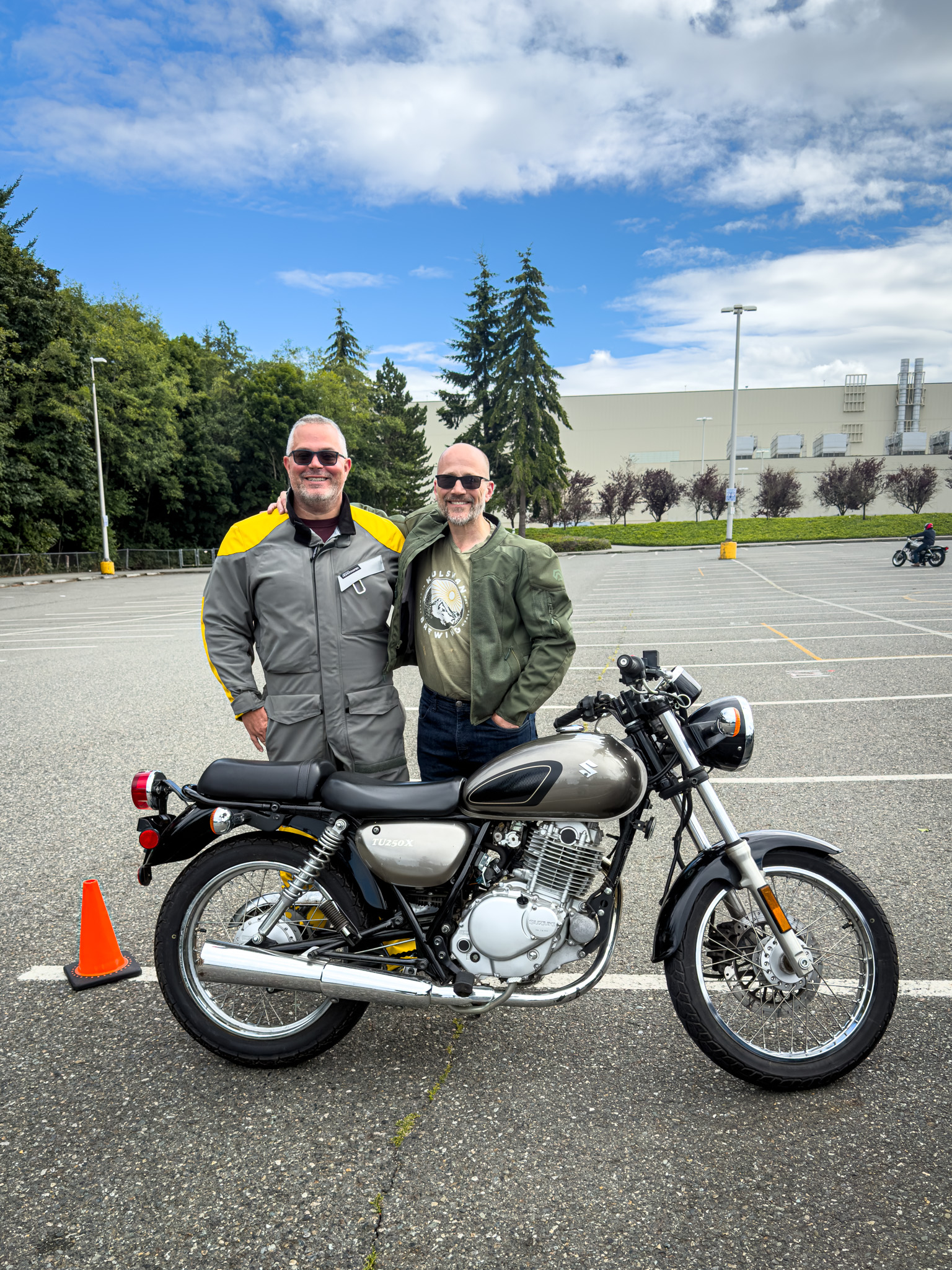
As I write this, I’m sitting on the deck looking out across the water. The motorcycle is parked in the driveway behind me. It’s a strange juxtaposition. Motorcycles weren’t part of my childhood or teenage years here — the driveway was full of cars of family and friends. Yet somehow seeing the GS sitting there feels freeing. The motorcycle represents almost everything that happened after I left this place, while the lake represents almost everything that happened before.


There’s a photo from a weekend I came here in college — me at twenty, sitting on a Harley in full leather gear, grinning at the camera. I had no business being on a motorcycle of that size yet. Looking at it now, what strikes me isn’t how young I look. It’s how much that picture was already pointing toward the person I was going to become. The bike. The gear. The expression on my face. I just hadn’t figured out how to read it yet.
Maybe that’s part of why this has hit harder than I expected.

It’s not really about a cabin. Places like this get sold every day. It’s about realizing that the places which shape us don’t stay ours forever. The people who filled them move away. The routines change. The seasons of life that once felt permanent quietly become memories. You know all of this intellectually — we all do. But every now and then something makes you stop and actually feel it.
Tomorrow I’ll ride north into the mountains before heading back toward Atlanta. The cabin will still be here when I leave, but not for much longer. The Adirondack chair I’m sitting in will belong to somebody else. The dock will belong to somebody else. The view across the water will belong to somebody else. What won’t belong to somebody else are the things this place gave me.

The lake has touched just about everything that makes me who I am. The friendships, the lessons, the confidence, the adventures, the willingness to leave home and build a life somewhere else — all of it traces back here in one way or another.
I didn’t love this place because it was easy. The difficulty in letting go is proof that I did.


Leave a Reply