
I don’t know what it is about the first weekend in May, but every year it seems overly packed. This year, the Hot Rodeo down in Palm Springs, the One Motorcycle Show in Portland, a cool Pashnit Ride, staying home, and the Central California BMW Club (CCBR) Spring Fling all competed for the same two or three days. Having just gotten off a plane from Canada with the East Coast coming up fast, staying home ranked higher on the list than it normally would have.
Then a new friend reached out and said there was a free ticket waiting for me at the Spring Fling if I wanted it. Someone couldn’t make it and had volunteered the spot to any club member who hadn’t been before. That ticket pulled on me hard. The future community connection pulled on me hard. I committed to find a way to make it work.
I’m a relatively new member of CCBR, and a lot of the guys who ride regularly live near me, which matters more than it might seem. Spring Fling is their big event of the year, and showing up signals something — commitment, engagement, or a genuine interest in getting to know people beyond a parking lot or online wave. The downside was that the math only worked one way: ride up late Saturday, ride back early Sunday, because realities at home were piling up fast. There was also a practical upside — the old GS had been sitting in the garage while the new GS and the Speed Triple got most of the love, and a long ride would burn through the old fuel and leave it with a fresh set of dinosaur juice. The things we tell ourselves to justify going riding.
I didn’t get rolling until almost five o’clock. The route was straightforward — I-80 to US 50, ending in a small Gold Country town called Lotus. I haven’t spent much time out that way, but the BARF Rally in Jackson last year taught me it’s both beautiful and more accessible than I’d given it credit for. Just over two hours of riding, which meant none of the commitment of heading into the high Sierra, and none of the coastal unpredictability where you can arrive to fog and a very wet camping experience.
Just about everyone I’d talked to about Spring Fling mentioned the food, so I sent a text ahead: please save a plate for me— hoping someone would get it and that cell service up at camp was decent.
It never ceases to amaze me what I-80 can become on a Saturday afternoon. Five o’clock, the weekend underway, and you’d think the freeway would be moving. Of course not. A car pulled over on the shoulder brought traffic to a crawl — as if cars are never on the side of the road. Construction in Sacramento breaths eternal. And then there’s the person parked in the left lane, backing things up for hundreds of yards while drivers jockey for position at a delta of two miles an hour, waiting for their moment to get around them causing more problems than they solve.
Once I left the freeway at Shingle Springs, everything changed. North Shingle Road is a two-lane country road, curves following the shape of the land, not a car ahead of me or behind me. I had the whole thing to myself for a few miles — and that right there is why I keep coming back to motorcycling.


I rolled into camp just before 6:30 as dinner was winding down. A couple of the guys called out: you’re here, let’s get you some food. It’s a small thing, being recognized and welcomed, but it lands differently when you’re still finding your footing as a newer member. The food lived up to the reputation — a deep green salad, salmon, spicy sausages, and a small piece of strawberry rhubarb pie that took me straight back to Alaska, where I first encountered that particular combination (not something a lot of us who grew up further south run into often). I entered into good conversations with people I knew, and met a few new faces — time well spent, even if the window was short.
When I heard that breakfast would be at 6:30, I laughed. Of course it would be. This is a BMW club, and at 50 I’m toward the younger end of the spectrum. Early breakfast, early departure — I knew exactly how Sunday morning was going to go from my time with the Northern California BMW Club. The same caterer handled the morning meal and didn’t disappoint — a full spread of quiches, pastries, a giant bowl of fresh fruit, freshly squeezed orange juice, and water. Camping has never been so luxurious. I’d heard there was rain in the forecast, but so far I’d managed to escape any of it, until now. When I dropped into the bathroom for the morning routine, the skies started to sprinkle. I got some Sunday morning love in my helmet from the clouds. Hopefully the water in the helmet dries quickly!


It’s been a while since I’ve ridden through the Delta. The Central Valley gets a bad rap — some of it deserved, honestly — but if you slow down and look around, there’s real gold out here. The Delta is one of those places.
The thing about the Delta in spring is the timing. It’s green enough to be genuinely beautiful, and you can ride with reasonable confidence that winter is actually over. Summer turns this area into a furnace — oppressive heat that makes anything beyond an early morning ride a miserable proposition. By fall, the vegetation is burned to a crisp. Spring is the window, and it’s shorter than people realize.
The levee roads add something the rest of the Valley can’t offer — real twisties, right there next to the East Bay. No altitude, no alpine drama, but the corners are still there. And as the soil shifts rapidly through the area, the pavement can make a sport bike rider feel like s/he’s on a dirt bike.
Leaving Lotus, I was sorting out the route home on Google Maps when Salmon Falls Road jumped out at me. With the club’s early-start culture working in my favor, I was on the road by 8:30 with the asphalt all to myself. The road was every bit as good as it looked — a gentle downhill run from the Gold Country into the Valley, tracing the contours of the landscape with nobody ahead of me or behind me. The American River carved a beautiful canyon through there, and Caltrans had the good sense to put a nice piece of pavement along it. My buddy in Sacramento mentioned later that Salmon Falls Road can turn into something of a racetrack for the local sport bike crowd on weekends — which made me glad I’d hit it early.


By the time I dropped down into the Delta in earnest, my low fuel light was on with about 20 miles of range remaining. I filled up at a gas station where a local three-patch club — all Harley-Davidson, all leather — made it quietly clear that an adventure bike wasn’t really their thing. (I’m sure they’re good folks under all that leather, but the GS and the Aerostich apparently didn’t help my case.)


Highway 160 is the main corridor through the Delta between Sacramento and Antioch, snaking through a network of waterways and islands on a gentle two-lane road across a series of drawbridges. The Delta feels genuinely different from the surrounding Central Valley — the sheer amount of water moving through the area changes everything about it: flora, fauna, temperature, humidity, and overall ethos. The culture out here leans conservative; you see signs protesting Gavin’s Delta tunnels, pushing back on water being funneled somewhere else – a stark contrast from the Bay Area. Farming and ranching dominate, with recreational boating along the wider stretches of river.
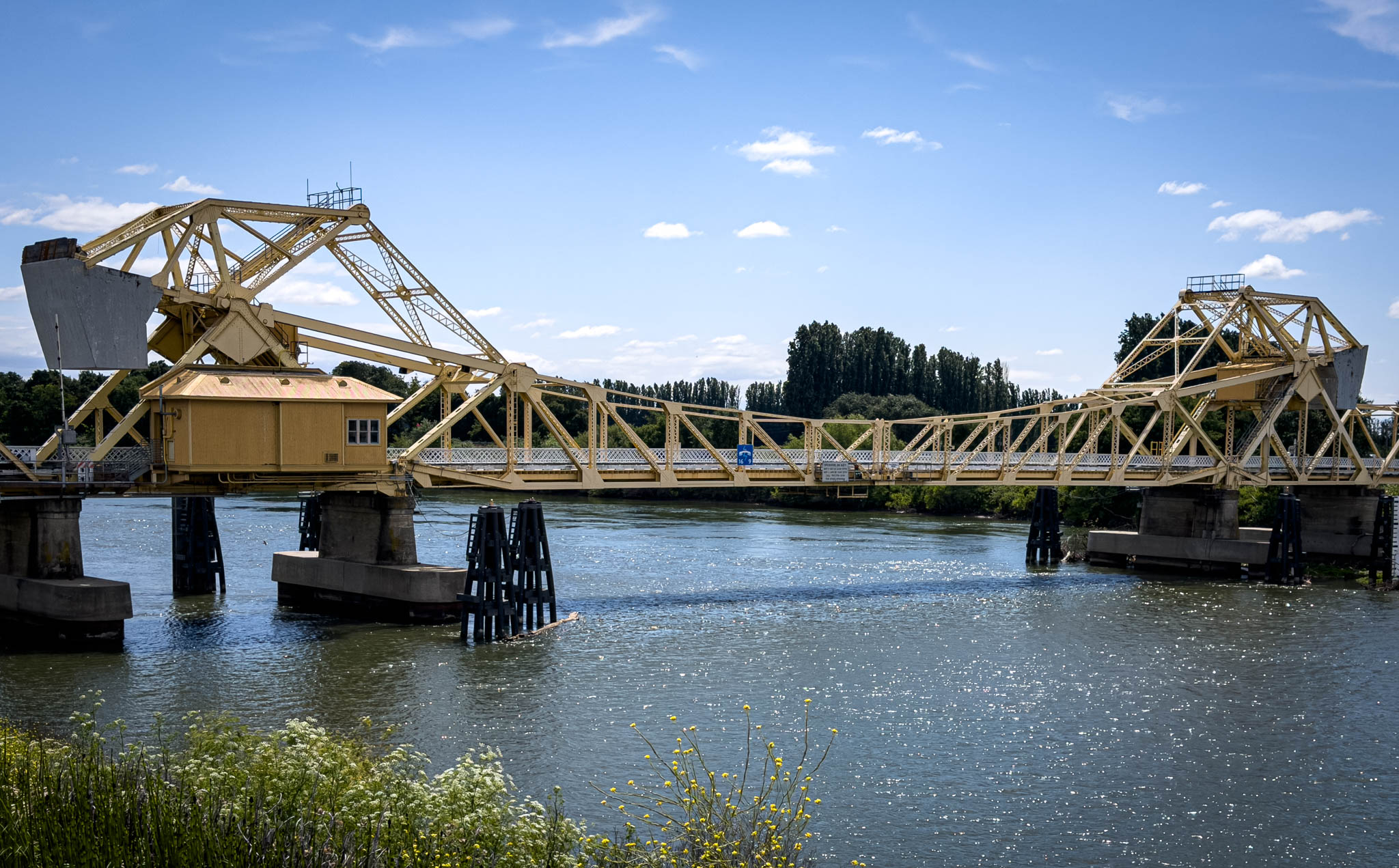
Heading south toward Antioch, I took in the drawbridges — their architecture, and the metal grating that always makes me squirm more than my tires do. My other goal was to ride the two ferries in the area: the Ryer Island Ferry and the J-Mack Ferry. Twenty-five years of California motorcycling and I’d never actually been on one of those boats. To get there, I ducked off CA-160 onto a smaller road cutting through the farmland. Everything was quiet. Life was good. I was deep into farm country, away from the steady flow of traffic that even Highway 160 carries between the Bay and Sacramento. Out here it was just me, the river, some crops, and the wind. I’d even save a few miles getting to CA-220, that elusive road with a ferry in the middle.

Then, out of the corner of my eye, a big red flash on my screen: Tire pressure set point not set. Pull over immediately. That’s my English version of ACHTUNG! The steering went heavy — exactly the way my instructor described it in the MSF course. I was in a blind corner, so I kept the bike moving for another few tenths of a mile, gently scrubbing speed until I could get to a safe spot on the shoulder.
It was about 2 o’clock, and everything about my day ground to a halt.
FUCK.
The TPMS sensor confirmed what I already suspected: rear tire pressure: zero. I walked around the bike slowly, looking for a puncture — right side, left side, tracking the valve stem through a full rotation. Nothing. No nail, no screw, no obvious wound anywhere in the tire.
What also struck me was how fast it happened. I hadn’t seen a yellow warning screen telling me pressure was getting low — the dash went straight to red. Whatever this was, it wasn’t a slow leak.
I pulled the valve cap off the rear and noticed something immediately: rubber around the base of the valve stem, bunched up in a way that didn’t look right. I pulled the cap off the front tire and compared — the valve core on the front looked clean, no buildup around it. The rear told a different story. The valve stem itself had failed, and when it went, the air left quickly rather than bleeding out gradually over miles. I had a tire patch kit in the bag, but a patch kit doesn’t fix a failed valve stem (I thought*). This was a tow situation. SHIT.

Good! Holds air 😍

Bad! Doesn’t hold air 🙈
I called AAA and they said a truck would be about 45 minutes out — a timeline I could work with. In the meantime, a local farmer slowed down and asked what happened. I gave him the short version. He asked if I needed anything, and I mentioned water. He came back with two bottles, didn’t make a production of it, and went on his way.
The tow truck showed up on time and immediately told me he couldn’t take the bike. No motorcycle towing equipment, even on a flatbed. All he could offer was that I should call AAA back for another service call — this despite the fact that I’d initiated the request through the app, specifically selected motorcycle, and entered the R1250 GS by make and model. That detail apparently never made it through dispatch.
I called back to a less-than-sympathetic rep and was told they were searching for another provider and would be in touch. No timeline or followup was given.

Not long after, another rider came by on a used BMW R1200R — had to be 10 or 15 years old, current registration was a creative work in progress, which was why he was keeping off the major roads. He stopped, we went over the tire together, and still couldn’t find a puncture. We chatted a bit, he realized he couldn’t do more than he’d already done, and eventually had to keep moving. I wished him smooth sailing with the CHP and meant it.
Forty-five minutes into the second service call, I phoned back. Still no confirmed plan. At that point I’d been on the shoulder for close to three hours with no plan from AAA. My water was running low, the temperature was dropping with the delta breeze picking up, and I was getting hungry. The nearest town was about five miles away — close enough to want to go, too far to walk if a tow truck actually showed up.
I explained the situation to the rep: Type 1 diabetic, supplies getting thin, first dispatch sent the wrong truck, weather getting colder, 15 years as a AAA Premier member specifically because Premier covers motorcycles. Since I don’t have the luxury of a car interior, motorcycle breakdowns carry a different kind of exposure than automobile calls — and after a failed dispatch, I needed someone who actually owned my case. What I got was unsympathetically: we’re working on it, and if you need emergency services, call 911.
I explained, as calmly as I could, that I didn’t need emergency services — I needed to speak with whoever was actually coordinating the tow so we could move things forward together. The answer didn’t change. I wrapped up the call, stuck on the side of the road, powerless to reach the people who were theoretically solving my problem.
About 30 minutes after that, AAA called back with a truck two hours away. I explained that I needed to leave the bike, get food and water, and that the truck would need to meet me in Walnut Grove before retrieving the GS. Under some pressure, they agreed. Their failed rescue became a much bigger problem and I needed to advocate for me here. Sitting on the side of the road was not an option anymore.
I opened Uber next. The app kept pairing me with the same driver, who kept declining — understandable given the location and a short ride, but one more thing not working in a day full of things not working.
Then the farmer came back.
He’d driven past earlier, seen the tow truck, and assumed I was gone. On a pass back across the field, something caught his eye. I saw your mirror sparkle while I was cutting the grass and wanted to come check on you. He asked if there was anything he could do. I said a ride into town would be everything right now. He laughed and said of course, had his son climb into the back seat to make room, and drove me in. By every measure that mattered, this farmer did more in ten minutes than a multi-million dollar company had managed in four hours.
The Pizza Factory in small-town California turned out to be exactly what I needed. The pizza was a solid eight. The guy at the next table offered good conversation. The restaurant was warm enough to take the chill off. An hour later, I checked the app — the two-hour tow hadn’t moved. I called the tow company directly. No answer. I called AAA and canceled the service call.
I didn’t want to call my buddy and ask him to drive all the way out. I pay for AAA precisely so I don’t have to make that call. But he came anyway, and when I tried to say something about it, he just said: that’s what friends do.
Lesson learned, and it’s an obvious one in hindsight: carry more margin for a motorcycle failure. It’s been close to 200,000 miles since I’ve been completely immobilized on the side of the road, and somewhere along the way I got comfortable. I had my phone, my Garmin, glucose tablets for any blood sugar issue — but not enough water, not enough food, and I hadn’t hydrated well enough that morning to begin with. A failed valve stem on a quiet Delta road shouldn’t become a five-hour ordeal, but when your margin is already thin, small failures compound fast.
Carry: phone, InReach, 1/2 L water per hour (3L), 500 calories of slow release food (protein centered). I would have been in a much better place with that. I’m updating my packing list now.
The whole experience took more out of me than I want to admit. I was supposed to be home by 4 PM and didn’t walk in until after 10. The AAA situation deserves a separate conversation, and I’ll be having it with them directly.
For now, I’m home, I’m safe, and the bike will get sorted. Monday will be hell getting everything back on track for the next week. I needed my Sunday night. I really did.
The Delta ride I actually wanted is still out there. Spring doesn’t last forever out there, but it’ll come back around.
I brought the wheel to #theTireSurgeon (Doug at Santa Clara Cycle Accessories) and we both agreed the cause of failure wasn’t obvious. Once the tire tech put high pressure on the rear wheel, the cause was clear. It turns out I ran over a razor blade and had a clear slash in the rear wheel, explaining the instant loss of pressure.



Leave a Reply