
The relentless tule fog had been sitting on the valley for weeks. Not just a few days with sun here and there, but literal weeks. Low 40s every morning, mid 40s throughout the day, my solar system throwing errors as it wasn’t getting enough sun. It was always gray until dark with everything being damp from the fog. I was done with it.
I grabbed the keys to the truck. I craved the heated seats, climate control to precisely 73 degrees and the oh so quiet cabin. No gear, no layers, just comfort. I was on North Gate Road by 10 AM.

Much like the valley, the base was completely socked in. Thick tule fog—the kind that just parks itself over the valley and refuses to move. Visibility dropped to maybe 50 feet once I started climbing. The yellow center line was all I had to work with.


Trees showed up as dark shapes, came quickly into focus, and then disappeared back into the fog. The road twisted through hairpins and I took them slow. A cyclist came out of nowhere, grinding uphill in his hi-viz jacket. I gave him room, a nod, and kept going.

The pavement was slick and beginning to get that algal film—not from rain, just relentless condensation. The fog was coating everything. Even with the heat on in the truck, I could feel that cold, damp weight in the air. I saw the fog dripping beads of water all over the truck. Even the wipers came on every so often.
Breaking Through
Around 1,700 feet, I started seeing light.

Just a glow at first, the light above was like someone had turned on a light above a thick curtain. The fog started to thin out. I could see into the oak groves on the sides of the road now—actual detail instead of just dark shapes.
The road kept climbing through that transitional layer. The fog was still thick around me but lighter overhead. Patches of blue started showing through. The yellow warning signs on the curves were catching actual sunlight now instead of just reflecting my headlights back at me.
The oaks in this section had their upper branches in sun while their trunks stayed wrapped in gray. Everything had this golden quality to it—the light filtering through what was left of the fog above me, warming everything up even though I was still technically in it.
Then the road climbed higher and I broke through completely. I was out.
Above
One second I was in that golden layer, the next I was in full sun under clear blue sky.


I pulled over. Had to look at that beautiful bright orange ball in the sky. My world could not have been more different.
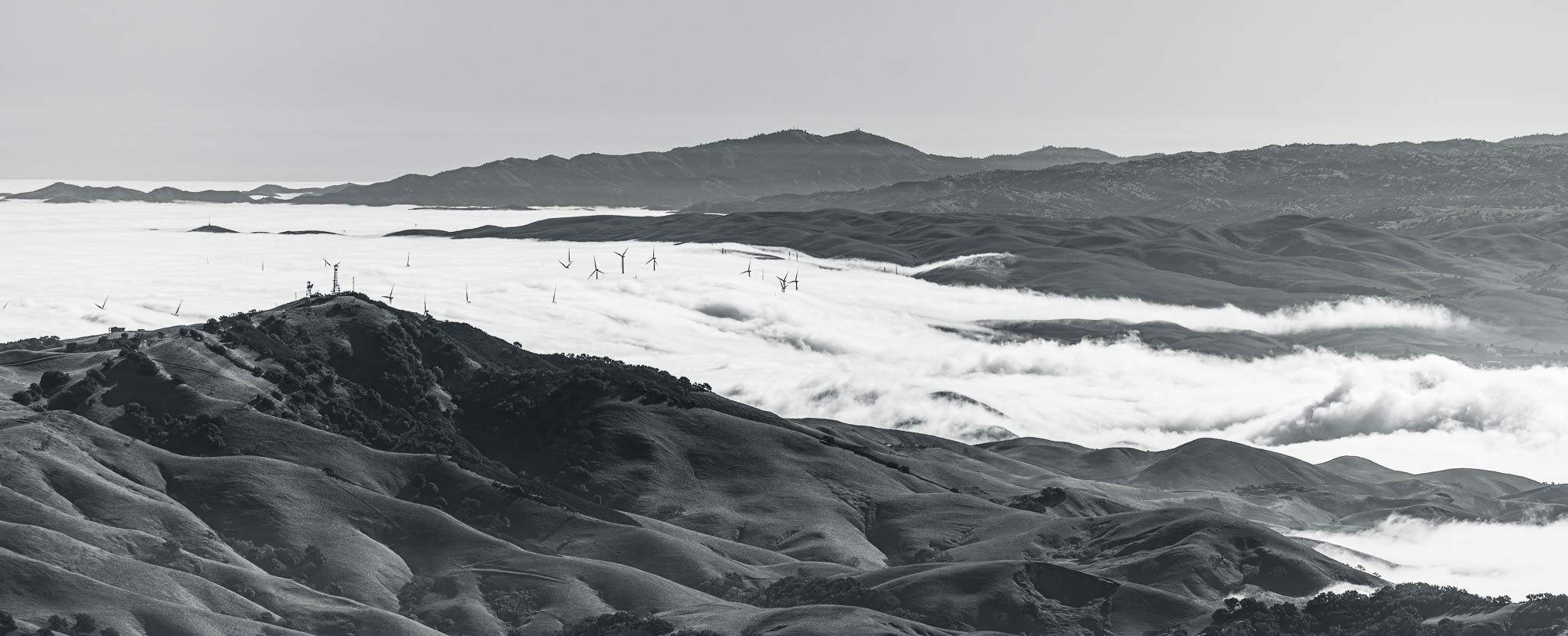
The fog sat below me like an ocean. It covered everything—the entire valley was locked under a solid white blanket. Not a single gap. I didn’t see a single clear spot down there. The whole Diablo Valley, Livermore, Tracy, all of it—gone under white. Just hillsides and ridgelines poking through like islands. Weather reports the same time showed suffocating fog from Redding to Bakersfield. The entire Central Valley was covered.
The fog sat below me like an ocean. Solid white blanket across the entire valley, smooth on top, hillsides poking through like islands. The road I’d just driven was visible above the fog line, then it just disappeared into white. I could make out the Sierra Nevada all the way to the east.
I cracked the window and the temperature difference hit me. Down in the fog it had been low 40s—I could still feel that cold dampness even with the heat running. Up here it was low 70s. The sun on my face felt incredible. After weeks of nothing but gray and cold, it was almost weird, like my body had forgotten warmth was a thing.
I kept driving toward the summit. The fog was moving now, behaving like actual weather instead of just sitting there. Pouring through gaps in the rocks. Spilling over ridgelines. In some spots streaming through in thick rivers, in others just filling valleys completely.
The eastern slope above the fog was clear—brown grass, rocks, that high-chaparral California look. The western slope was buried under white. Two totally different worlds maybe a quarter mile apart.
At the summit I could see the Altamont wind turbines, way out in the distance. Rising above their own fog layer. Dozens of them spinning slowly in the sun.

At the summit I ran into a couple of retired PG&E guys exploring the park. Being a bit of an electrification nerd, we started talking.
Both of them had put in 30+ years on the grid. The conversation flowed as it often does with people who actually know the system. They called out the grid’s tech debt that nobody wants to pay to fix. They further explained that much of it was infrastructure built for a completely different era trying to handle loads it was never designed for.
One guy described it like trying to turn a 1950s Chevy into a Tesla by just bolting on new parts. The grid was built for centralized power plants pushing electricity one direction. Now we’re increasing demand, adding rooftop solar, batteries, power flowing both ways, and we haven’t rebuilt much of the foundation for any of it.
CPUC came up. The politics of it. Trying to keep rates low while also funding infrastructure upgrades, boutique ways of generating power, wildfire mitigation, and grid hardening. Everything takes years to approve while the equipment keeps aging. “Nobody wants to be the one who approves a rate increase,” one of them said, “but everybody wants their lights on and no fires.”
Then we added in electrification. The state is pushing it hard—EVs, electric heating, electric everything. But the infrastructure isn’t there. One of them talked about transformers in neighborhoods that were built in prior days. Add three or four EVs to a street and you can overload equipment that was never designed for that kind of load. “We’re asking people to electrify everything,” he said, “but the grid’s not ready for it.”
An hour flew by. I walked around a bit. Sat in the sun. Looked out at those wind turbines—renewable energy already happening in pieces even if the grid to handle it all isn’t there yet.
Down
I headed back down.
It was like driving back into winter. The warmth disappeared around 1,700 feet. Fog closed in. Cold and thick. By the time I got to the valley floor it was like I’d never left. Low 40s. Gray. Dense.

But the sun was still up there. A thousand feet above all that gray.


Leave a Reply